by John Curtice and Stephen Fisher, 1st May 2024.
Seats won and lost in the local council elections in England this week may be a poor guide as to how well the parties performed. Since the elections are held under single or multi-member plurality, without any increase in support a party may make big gains in seats off the back of another party losing votes. A third party whose vote is geographically spread may make a substantial advance in votes yet reap little reward in terms of seats. Meanwhile, seats won and lost only provide an indication of whether a party has lost or gained ground as compared with when the seats up for grabs were last contested.
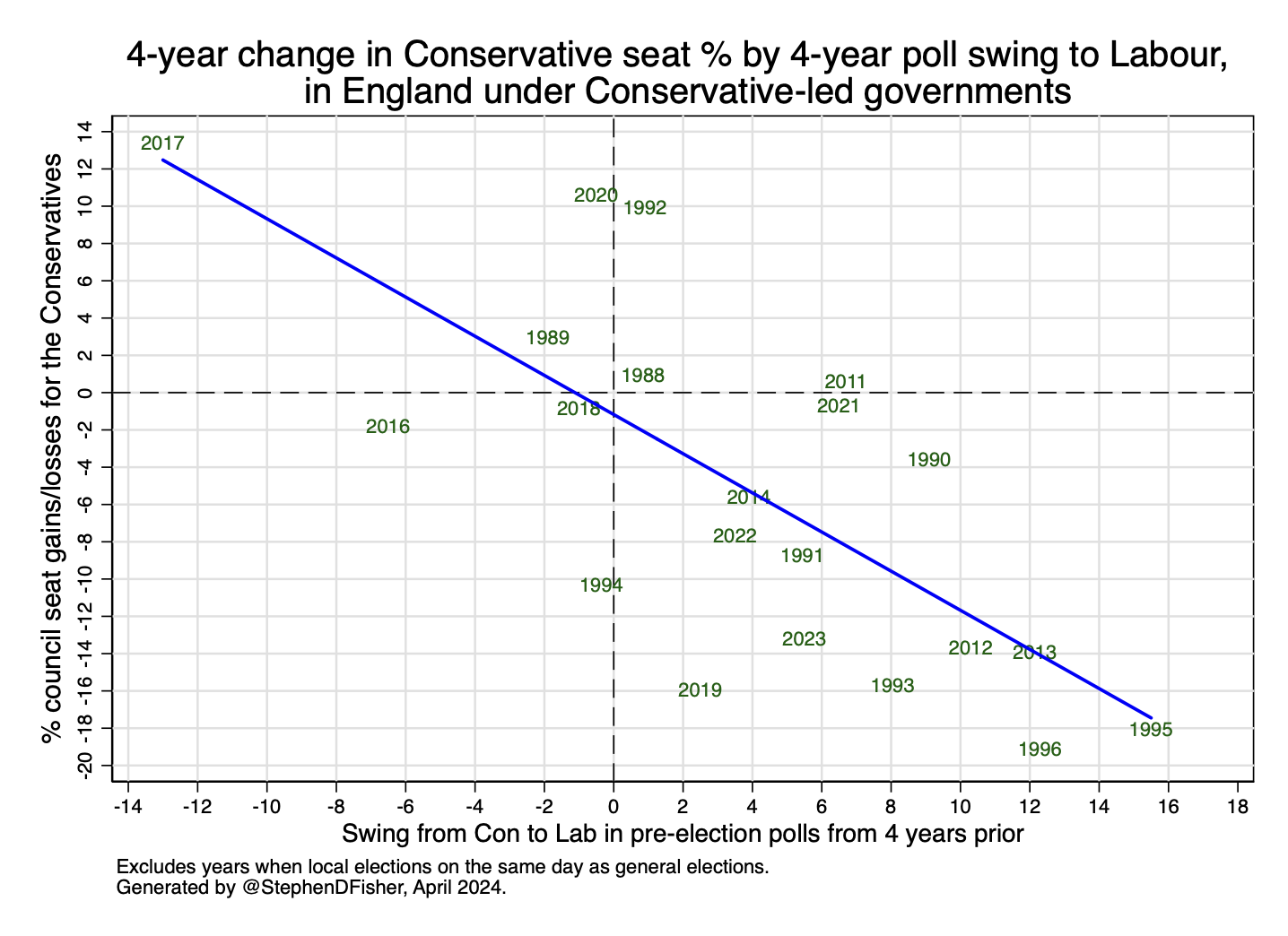
These caveats are important again this year. Around 70% of the council seats up for grabs this year were last fought over in May 2021. Boris Johnson was Prime Minister and the Conservatives were successfully claiming the credit for an early Covid vaccine rollout. The party enjoyed a six-point lead in the polls, gained over 200 seats in the local elections and recorded their best performance in terms of votes since 2017.
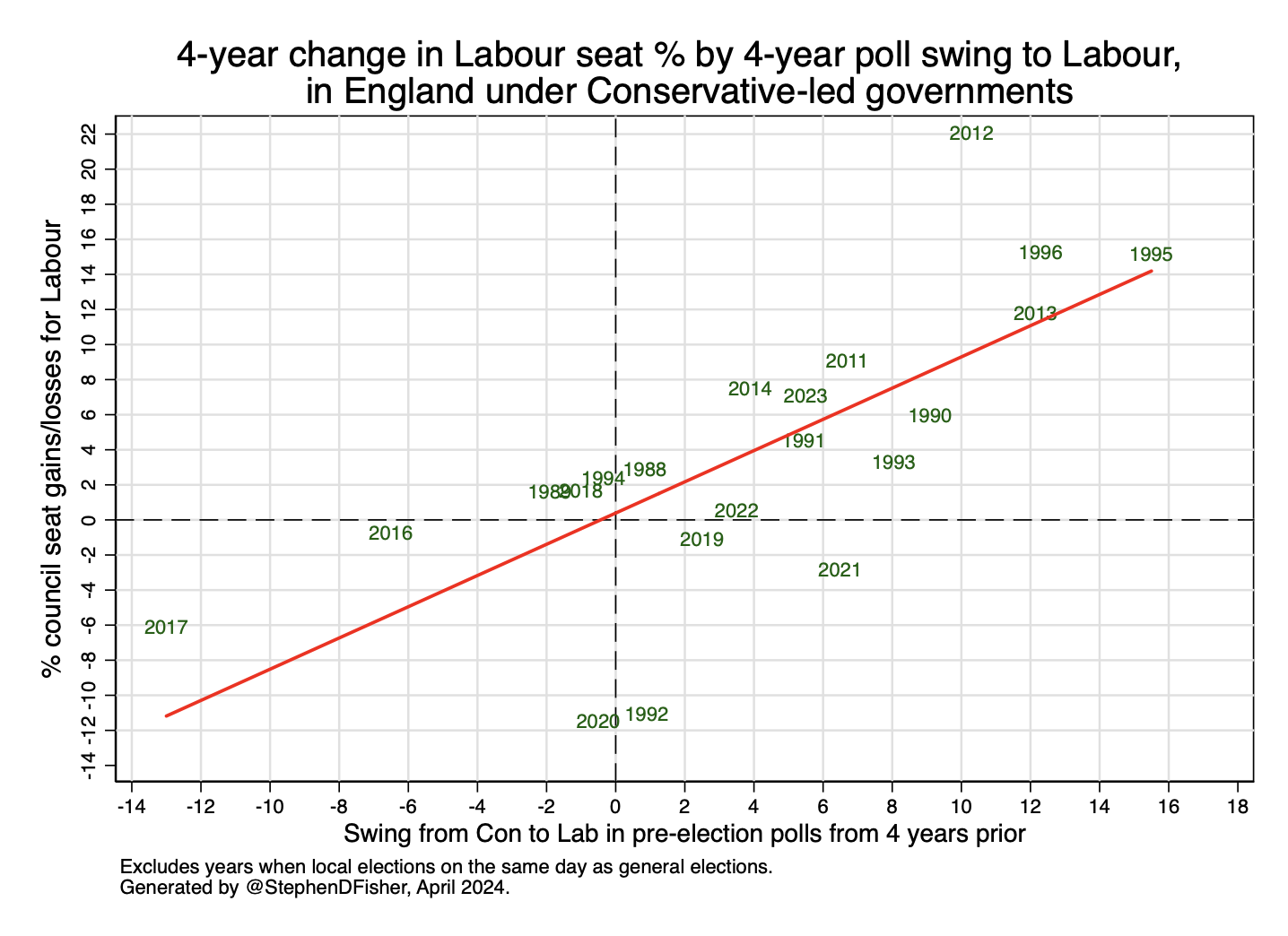
The Conservatives therefore face the challenge this week of defending a strong baseline while running 20 points behind in the polls (an even weaker position than this time last year). They look set to make significant losses. Other parties, such as the Liberal Democrats, may gain seats purely as a result of the decline in support for the Conservatives, without necessarily attracting more voters themselves.
That said, one key uncertainty is that Reform UK are only fielding candidates in one in six of the wards where local elections will take place. According to the polls, the Conservatives are now losing more of their 2019 voters to Reform than any other party. Perhaps some of these voters will switch to the Conservatives where Reform are not on the ballot paper, thereby helping to stem Conservative losses.
Yet we cannot assess party performance by simply adding up the votes cast (even if we had the resource to collect them all on election night). In England (unlike Scotland and Wales) it is never the case that the whole country votes in local elections at the same time. The places that vote one year are politically different from those that vote in another.
Continue reading Understanding the Local Elections Projected National Share (PNS) in 2024 →

 Elections Etc