
By Stephen Fisher, 2nd May 2025.
Updated with all of Thursday’s election results in. That is 23 councils, 1639 seats across 1399 wards/county electoral divisions, 6 directly-elected mayoralties, and 1 parliamentary by-election.
Verdict:
Extraordinary for Reform, good for the Liberal Democrats, mixed for Greens, bad for Labour, and extremely bad for the Conservatives.
The graph below gives you a sense of how dramatically things changed this year. For an explainer of the PNS see here.
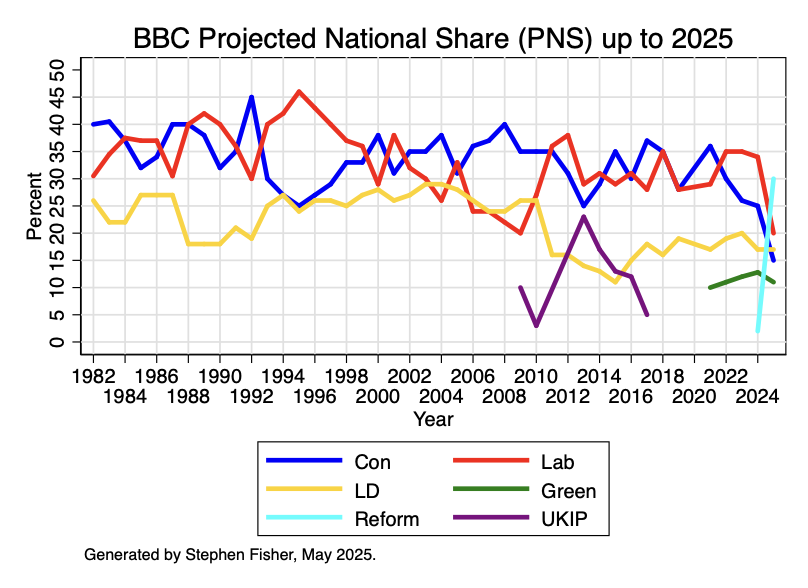
Reform UK:
- Top of the poll, with 30% in the BBC Projected National Share (PNS) of the vote, up from just 2% in last year’s local elections (due to not fielding many candidates in 2023). Reform comfortably beat UKIP’s best result of 23% in 2013.
- Won control of +10 councils, despite starting with no seats at all: Derbyshire, Doncaster, Durham, Kent, Lancashire, Lincolnshire, North Northamptonshire, West Northamptonshire, Nottinghamshire, and Staffordshire.
- Largest party on a further 4 councils that are “No Overall Control”, so 14 out of 23 in total: Cornwall, Leicestershire, Warwickshire, and Worcestershire.
- Won the popular vote in 14 authorities.
- Won the Runcorn and Helsby parliamentary by-election, albeit by just 6 votes, with a 17-point swing. Overturning a majority 34 points or more has only happened in 17 previous by-elections.
- Won 677 council seats: 41% of the total.
- Won the Greater Lincolnshire and Hull & East Yorkshire mayoralties, and came a close second in Doncaster, North Tyneside and the West of England
Conservatives:
- Dropped to 15%, and 4th place, in the BBC Projected National Share (PNS) of the local election vote: their lowest ever, and lower than any share Labour have ever dropped to since records began in 1982.
- Lost control of all 16 councils they were defending.
- Largest party in just 2 councils: Buckinghamshire and Northumberland.
- -674 net council seat losses: 68% of the 993 they defended.
- Won just 1 of the 6 directly elected mayoralties, despite 3 or maybe 4 being in areas they traditionally would have expected to win. They only won Cambridgeshire & Peterborough from Labour because of a change in the electoral system from supplementary vote to first past the post.
- Came a distant third in the Runcorn and Helsby parliamentary by-election, despite this being a notional Labour-Conservative marginal in 2019.
Labour:
- 20%, down from 34% last year, in the BBC Projected National Share (PNS) of the local election vote. This is the lowest level for Labour since 2009, which took place in the aftermath of the 2008 financial crisis and MPs expenses crisis, and the last round before Labour lost power in 2010.
- Narrowly held Doncaster, North Tyneside and the West of England mayoralties. Lost Cambridgeshire & Peterborough because of a change in the electoral system to first past the post (they won in 2021 thanks to transfers under the supplementary vote system). Failed to win the Hull & East Yorkshire mayoralty.
- -187 net council seats losses, 66% of the seats they were defending, leaving them with just 99, putting them in forth place with not many more than the Greens (79).
Liberal Democrats:
- 17% in the BBC Projected National Share (PNS) of the local election vote, matching their 2024 local election performance.
- Gained control of +3 councils: Cambridgeshire, Oxfordshire and Shropshire.
- Largest party 4 further councils: Devon, Gloucestershire, Hertfordshire, and Wiltshire
- Topped the poll in 7 authorities.
- +163 net council seat gains, taking them to a total of 370. That is the second highest total after Reform’s 677, and comfortably above the Conservatives’ 319.
Green Party:
- 11% in the BBC Projected National Share (PNS) of the local election vote.
- +44 net council seat gains on top of the 35 they successfully defended, thereby increasing their total number of seats up by 126%.
- Disappointed to come third, with a 1.7-point drop in their vote, in the West of England mayoral contest; a contest polls suggested they might win.
See analysis by John Curtice and the rest of the BBC team for further detail here.
Thanks to the BBC for help with the data.
 Elections Etc