
By Stephen Fisher, 19th March 2026
What follows is not a forecast, but an analysis showing that Reform UK need to make at least +2050 net seat gains in the English local elections to show they are still performing as well as they did at last year’s local elections and +1935 to be on par with local by-election results since then. However, given that last year Labour lost seats to Reform at a faster rate than did the Conservatives and this year Labour are defending more seats, Reform could make as many as +2270 net gains without that necessarily indicating any significant progress in their ability to win council seats.
If the polls are anything to go by Reform should do even better this year than they did last year. Reform are up three points in the general election vote-intention opinion polls. More relevant, however, is the +26 points rise in Reform polling relative to four years ago when most of the seats up for election this year were last fought. That +26 is three points larger than the corresponding +23-point poll rise Reform were enjoying at the time of last year’s local elections relative to four years prior. Also, Reform have extended its poll leads over the Conservatives and Labour since last year both absolutely and relative to four years prior. On that basis, the polls suggest that Reform should exceed their local election performance from last year.
Last year’s local elections were extraordinary though. From practically a standing start, the net gains for Reform UK amounted to a record-breaking +41% of all the seats up for election.
If Reform repeat that scale of success this year they will make +2050 net seat gains from the 5010 or so seats that will be contested in the English local elections in May. That would comfortably beat the +1661 gains that Tony Blair’s Labour party achieved in England at the 1995 local elections.
Reform’s gains last year were also extraordinary relative to the previous failure for either Reform or UKIP to translate opinion poll strength into substantial numbers of council seat gains, as shown in the graph below. Most striking is the contrast between 2025 and 2024, when the +11.5-point rise in Reform polls (relative to the Brexit Party in 2020) yielded just two seats.
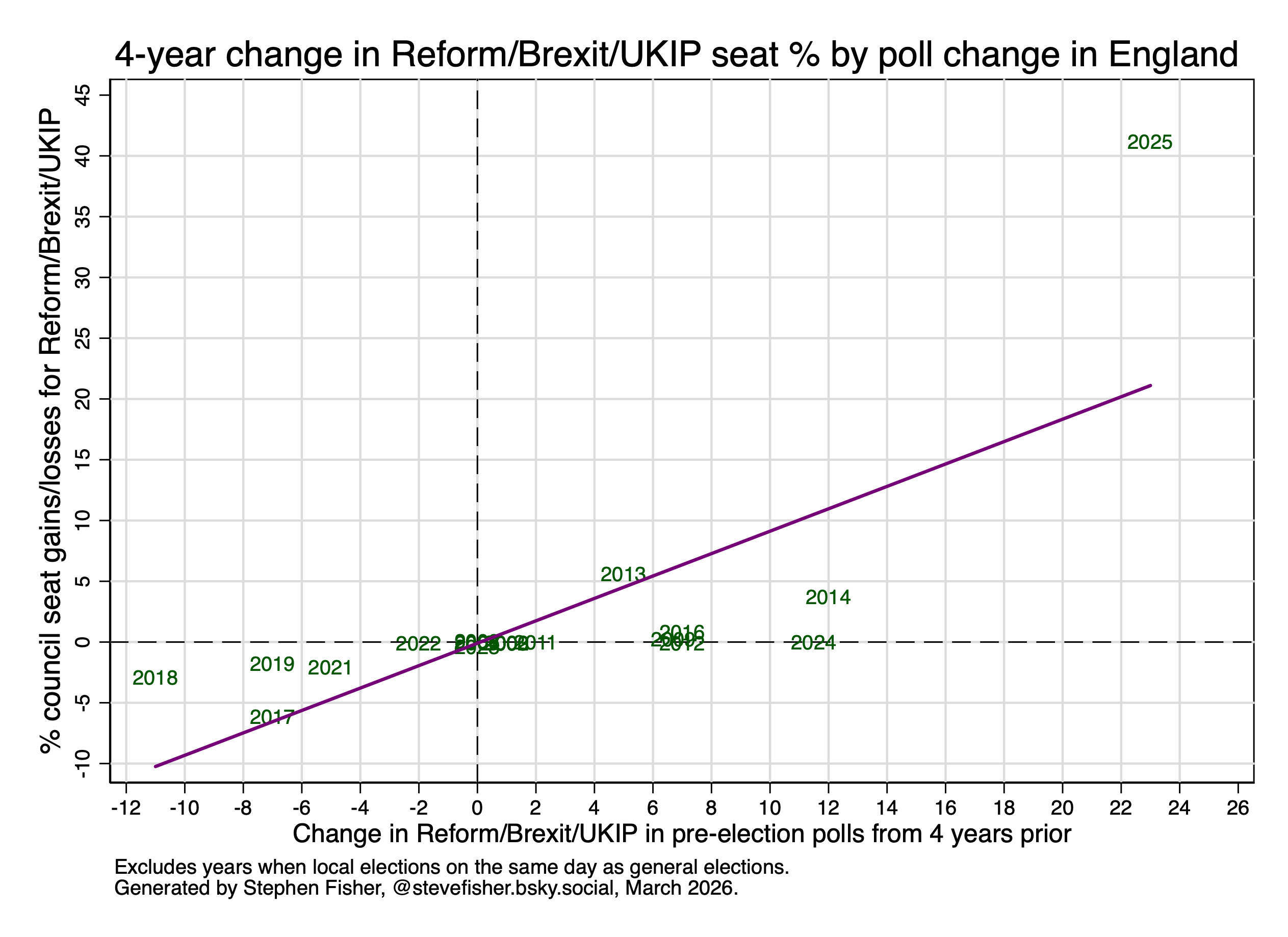
That Reform won 41% of council seats up with just 31% of the votes cast and an even lower 30% in the BBC Projected National Share (PNS) is unusual but not unprecedented. In 2019 the Conservatives won 42% of the seats with 31% of the vote and a PNS of 28%. Similarly, in 2010 Labour also won 42% of the seats with 32% of the vote and a PNS as low as 28%. Now that Reform is the most popular party in English politics, the electoral system works to the party’s advantage.
Reform gains last year overwhelmingly came from the Conservatives and Labour and barely at all from seats the Liberal Democrats or Greens were defending. While Reform gained 41% of the seats overall, roughly speaking (because of multimember wards) the Conservatives lost 48% of their seats to Reform, and Labour a massive 63%.
Last year the Conservatives were defending 993 seats to just 285 for Labour. This year, Labour are set to defend as many as 2557 seats to just 1364 for the Conservatives. If Reform again take 63% of the Labour seats and 48% of the Conservative seats that will give Reform +2270 seats: some 45% of all the seats up.
To the extent that the headline seat gains are a measure of party performance at the local elections, Reform need more than +2270 net gains to really provide convincing evidence of the improvement that opinion polls suggest they have made since last year.
In local by-elections since last May’s big round of local elections, the Conservatives have suffered net losses to Reform of 51% of seats they were defending, similar to last May. The corresponding figure for Labour is 42%. That is somewhat less that the 63% rate of seat losses to Reform last May but still substantial. If replicated this May, those rates of seat changes imply Reform taking +1770 seats from the Conservatives and Labour alone.
In contrast to the big losses in local by-elections for the traditional big two parties, Reform actually lost a seat to the Greens and made only a single net gain from the Liberal Democrats over the past year. However, Reform has scooped up some 62% of the by-election seats that were previously held by Independents and Others. If that is repeated in May, then Reform will make a further +165 net gains. Adding those to the seats projected to come from the two main parties suggests Reform are on course to make +1935 net gains if May’s elections follow the pattern of local by-elections over the past year.
Reform might not gain so many seats at such a rate because some 36% of the seats up are in London. At the 2024 general election just 9% of Londoners voted Reform compared with 15% for England as a whole. However, fully 28% of seats up are in Metropolitan boroughs in the Midlands and North which were close to as or more likely to vote Reform at the general election than England as a whole. These include Greater Manchester (17% Reform in 2024), Merseyside (14%), South Yorkshire (15%), West Midlands (17%), West Yorkshire (16%) and as much as 22% for Reform in the Tyne and Wear Metropolitan area. Moreover, many of the county, district, and unitary council seats up are in areas that are relatively favourable for Reform. So, any relative underperformance by Reform in London might well be offset somewhat by better than average success elsewhere.
Reform did so well last year, and in local by-elections since last year, that they have set themselves extremely high benchmarks against which their performance this year may be judged.
Many thanks to Colin Rallings, Michael Thrasher, David Cowling, Rob Ford and the BBC for help compiling local election data over the years.
 Elections Etc