In recent years, changes in vote-intention opinion polls have generally provided a reasonable guide to headline gains and losses at local elections. Most of the seats up this year were last fought in 2021. Table 1 shows how party support in the opinion polls has changed since then. Reform UK are ahead, just, and never before in England has vote intention been so evenly divided between five parties.
Table 1. Opinion poll changes from 2021 locals to 2025 locals (GB)
%
2021 polls
2025 polls
Change
Con
41
23
-18
Lab
36
24
-12
LD
7
13
+6
Reform
2
25
+23
Green
5
9
+4
How might these changes translate into net changes in local council seats?
By Stephen Fisher, John Kenny, Paul Furey, and Polina Ryzhuk. 3rd July 2024.
10am, 4th July. Updated to correct a minor typo. Forecasts published since the post below was published late last night but before polling stations opened this morning (and any we missed) will be incorporated in the evaluation after the results. So far it looks like those additions would make little difference to the tables below. Thanks to all the forecasters for their contributions.
The average of different kinds of seats forecasts points to a Labour majority of 194 in tomorrow’s general election. Changes since last week are: Conservative +8, Labour -3, LD +4, Reform +1, SNP -2, and no change for the Greens and PC. Those changes are partly due to moves in the betting markets, perhaps in response to polls that improved for the Conservatives, and new complex models (listed in the sources section below). However, MRP projections have worsened for the Conservatives. They are now forecasting an average of just 85 seats for the party.
Guest post by, John Kenny, University of East Anglia, and Michael S. Lewis-Beck, University of Iowa, 3rd July 2024.
The snap election for the UK general election takes place tomorrow, with the vote intention polls, as aggregated by the BBC Poll Tracker, showing Labour with an 18 percentage point lead over the Conservatives. This gap indicates a serious Conservative loss. But are these vote intention data that accurate? The question seems worth asking, especially in the context of public opinion polling uncertainties surrounding this, and other previous, snap elections. (See the recent comprehensive review by Stegmaier, Jokinsky, and Lewis-Beck, 2023). An alternative to the vote intention approach to forecasting elections involves the use of structural models, in particular political economy models, which rest on the idea that political and economic fundamentals shape election outcomes. One such model, rolled out in 2001, forecast in advance of the contest the victory of the Labour party in that year (see Lewis-Beck, Nadeau, and Bélanger, 2004).
Guest post by Andreas Murr, CIDE and University of Warwick. 1 July 2024
Voters will choose the next British prime minister this Thursday 4th July 2024. The political parties narrowed down this choice much earlier. The Labour party chose Keir Starmer as their leader on 4 April 2020; the Conservative party chose Rishi Sunak as their leader on 24 October 2022. One of them will be the next prime minister. Does their selection as party leaders tell us anything about who will be selected as prime minister?
By Stephen Fisher, John Kenny, Paul Furey, and Polina Ryzhuk. 26th June 2024.
The average of different kinds of seats forecasts points to a Labour majority of 200; the same as last week. There is very little change for other parties, except that the average forecast for the Conservatives is down from 127 last week to 123 this week. That is despite a rise for the Tories in the simple-model projections (uniform change from opinion polls). The Conservative seat forecast is down in both the non-MRP complex models and the MRP average, which is now forecasting just 92 seats for the Conservatives. That average is now based on 9 different MRP models.
By Stephen Fisher, John Kenny, Paul Furey, and Polina Ryzhuk. 19th June 2024.
All the different sources still point to a large Labour majority. On average across the different kinds of forecast, the predicted majority is, at 200, up eight from last week. The combined forecast for the Conservatives is down by nine seats, and that for the Liberal Democrats is up by seven seats since last week. Those changes have been largely driven by changes in MRP projections, but other sources have also typically changed in the same direction.
By Stephen Fisher, John Kenny, Paul Furey, and Polina Ryzhuk. 12th June 2024.
All the different sources of seat forecasts still point to a large Labour majority. On average across the different kinds of forecast, the predicted majority is 192, down slightly from 197 last week. The Liberal Democrat forecast has crept up from 36 in our first forecast, to 37 last week, to 41 today. The betting markets are more optimistic for Reform UK winning seats than the poll-based models, as they were last week.
By Stephen Fisher, John Kenny, Paul Furey, and Polina Ryzhuk. 6th June 2024.
All the different sources of seat forecasts still point to a large Labour majority. On average across the different kinds of forecast, the predicted majority is 197. That is up slightly from the 188 average majority in our first combined forecast this time last week.
Table 1. Seat Forecasts
Betting Markets
Complex models
Simple models
MRP
Average
Con
118
144
195
114
143
Lab
424
434
392
444
424
LD
42
32
28
45
37
Reform
3
0
0
1
1
Green
1
1
1
1
SNP
19
16
13
24
18
PC
3
3
3
3
Lab majority
199
217
134
238
197
The increase is largely due to the higher Labour forecasts from the MRP models, which are listed in Table 2. They are remarkably different from each other, ranging from a Labour majority of 114 to as much as 324. The forecast number of Conservative seats in the MRP projections range from 66 to 180. A key part of the differences between the MRP projections for the Conservatives and Labour is the degree to which the models expect party performance to be proportional to the prior Conservative vote share. By comparison, traditional uniform change models (under simple models in Table 1) produce more modest forecasts for Labour gains and Conservative losses.
By Stephen Fisher, John Kenny, Paul Furey, and Polina Ryzhuk. 30th May 2024.
Here we combine seats and vote share forecasts from a variety of sources including betting markets, polls, statistical forecasting models, and citizen forecasts. As well as updating weekly, incorporating new forecasts with different methods as they become available, there may be developments in the methodology. Comments welcome.
All the different sources of seat forecasts in Table 1 point to a very large Labour majority, well over 100.
Changes in vote intention opinion polls typically provide an indication of headline net seat changes at local elections. Most of the seats up this year were last fought in 2021. The following table shows how party support in the opinion polls has changed since then.
Table 1. Opinion poll changes from 2021 locals to 2024 locals
%
2021 polls
2024 polls
Change
Con
41
23
-18
Lab
36
44
+8
LD
7
9
+2
Reform
3
12
+9
Green
5
6
+1
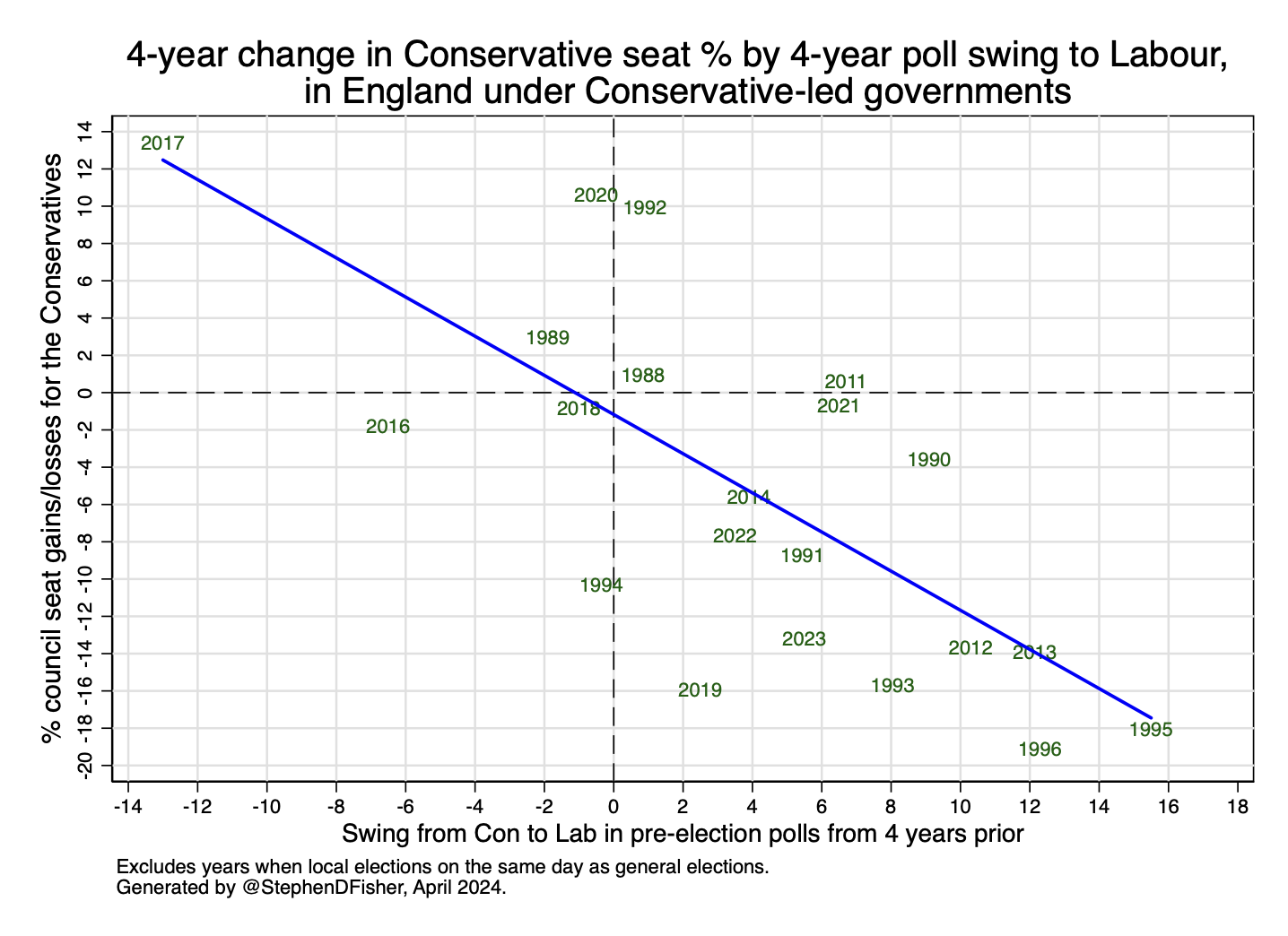
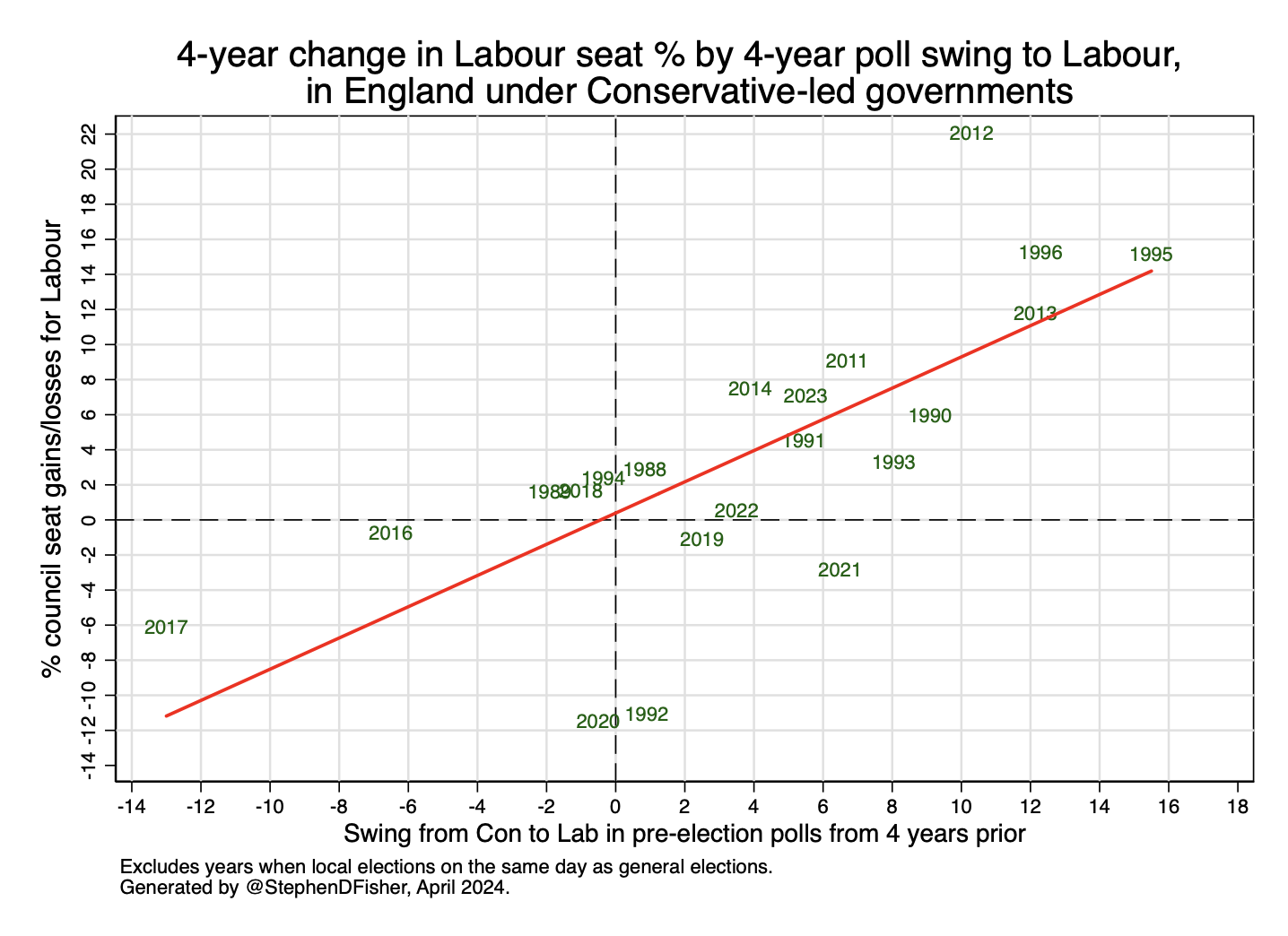
Those changes imply a 13-point swing from Conservative to Labour. The graphs below show broadly how that might translate into seat gains for Labour and losses for the Conservatives as percentages of the 2650+ seats up this year. The 13 point swing should put this week’s local election results on par with those for 1995, 1996 and 2013.
Liberal Democrat local seat tallies at the national level have historically been linked primarily on the swing between them and the Conservatives. That swing is 10-points to the Liberal Democrats this time.
Table 2 below shows predictions from the regression models. The figure for Others is just an accounting balance. The Conservative and Labour models are based on Con-Lab swing and the Lib Dem model is based on Con-LD swing. The three are estimated separately. They do not take direct account of the rise in the Reform party share, nor perhaps more importantly given their success last year, the big rise in the number of Green party candidates relative to the number of seats up for election.
Table 2. Model based forecasts for English local election net seat gains/losses for 2024
Forecast
Con
-390
Lab
+320
LD
+100
Others
-30
Based on last year’s experience, I would expect the Conservatives to do worse than the model suggests, and the Liberal Democrats and Others (mainly Greens) to do better.

 Elections Etc