In the Scottish Parliament elections yesterday the SNP lost 6 seats and their majority because their share of the list vote fell by 2 points. They ended up with 49% of the seats from 42% of the vote. Meanwhile, at the Welsh Assembly elections Labour’s vote share dropped by 5.4% points but they lost just one seat, finishing with 48.3% of the seats from just 31.5% of the vote.
The SNP went into yesterday’s Scottish Parliament elections defending a majority of 9, and with many expecting that they would manage to achieve another majority on the strength of their performance in the constituencies alone.
Indeed the SNP managed to improve on their 45.4% share of the constituency vote in 2011, with 46.5% this year. Moreover, Labour dropped from 31.7% in 2011 to 22.6%. This represents a Lab to SNP swing of 5%, which should have been enough for them to take 13 seats from Labour. That number, on top of the 53 constituencies they won in 2011 would have yielded the SNP 66 constituencies on a uniform swing, a majority of 3 before looking at the regional list seats.
Much of the speculation about what might happen in the English local elections tomorrow has focused on how many seats each party – and especially Labour – could or should gain or lose. Indeed, we can expect many a judgement to be cast on Friday on the basis of this evidence. However, given that these elections are held under first past the post, seats won and lost can be a poor guide to how well a party has done in the ballot box. A party whose vote has fallen less than that of their principal rivals may gain seats even though it has lost votes. A third party whose vote is geographically spread may make a substantial advance in votes yet reap little reward on terms of seats. Meanwhile, even if these issues do not arise, seats won and lost only provide an indication of whether a party has lost or gained ground as compared with when the seats up for grabs were last contested – which (as this year) is usually four years ago. Continue reading Calculating the Local Elections Projected National Share (PNS) in 2015 and 2016→
There is a lot of evidence from the academic research on forecasting that suggests it is a good idea to combine information from different sources (e.g. here). In US and German elections generating a forecast by combining the forecasts of others has a good track record. For the upcoming US presidential election pollyvote.org provides an average of different forecasts together with excellent summaries and discussions of the different methods and forecasts.
We have developed a similar method of combining forecasts for the UK’s referendum on EU membership on 23rd June 2016. The summaries of the average forecast win-probability and share of the vote for Remain by method and then overall are presented in the tables below. Note that there are different components for each because some of the source forecasts provide only probabilities or only vote share.
Local elections are supposed to be about local matters, but the electoral fortunes of councillors and would-be councillors depend very heavily on the popularity of their parties nationally. So the outcome of this year’s local elections depend on how the current standing of the parties compares with four years ago when the seats up for election this year were last contested.
In the run up to the 2012 local elections Labour were polling above 40% with a solid 9 point lead over the Conservatives, in part because of the so-called omnishambles budget. Meanwhile the Liberal Democrats had slumped in the polls after the formation of the coalition government with little over 11%.
According to the average of the most recent polls from six companies, Labour have dropped since 2012 to 35% now, only narrowly ahead of the Conservatives who are on 34%. The Liberal Democrats have slid even further to just 7%. On this basis alone we should expect both Labour and the Lib Dems to lose substantial numbers of council seats while the Conservatives should make gains from their 3-point recovery. Continue reading Forecasting Local Election Seats 2016→
A month ago we issued our first forecast for the EU membership referendum on 23rd June 2016. Based on an analysis of referendums in the UK and on the EU outside the UK, and on vote intention opinion polls we forecast that Remain had an 87% chance of winning, and that Remain would get 58% of the vote, plus or minus 14. This was in part based on our polling average (excluding Don’t Knows) of 55% for Remain on 11th March.
Our current forecast suggests the contest is a fair bit closer. Our polling average now puts Remain on 52%. We now give Remain a 73% chance of winning and estimate that the Remain share of the vote will be 54% plus or minus 13 points.
The UK will have a referendum on whether to remain in or leave the EU on 23rd June 2016. We have developed a method for forecasting the outcome based on current vote intention polls and analysis of opinion polls from previous referendums from the UK and across the world. Continue reading First Forecast for the Brexit Referendum→
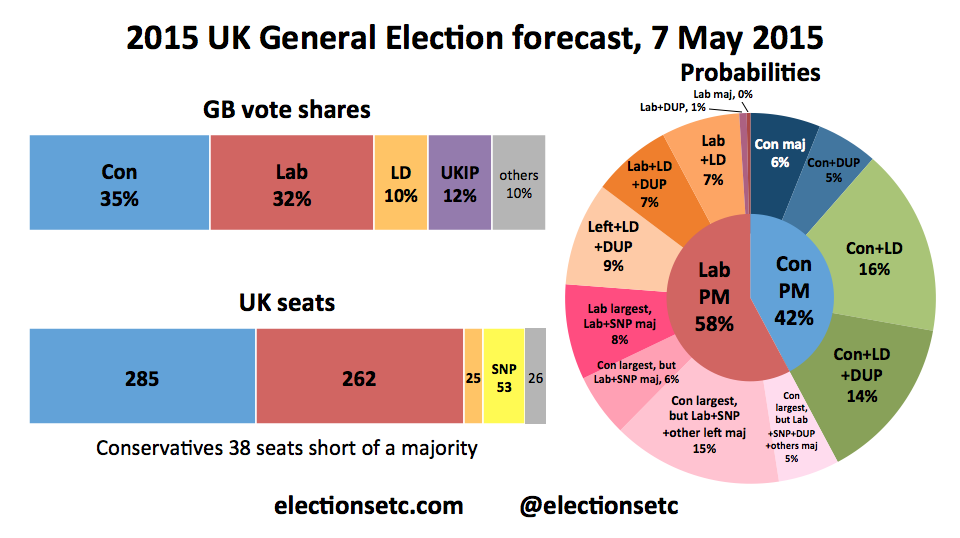
The election outcome was a shocking defeat for Labour and a remarkable victory for the Tories, both relative to expectations from the opinion polls and considering that you have to go back to Salisbury in 1900 to find an instance of a Prime Minister increasing their share of the vote after being in power for more than 18 months. Overall Labour will be just a point up on the abysmal 30% of the GB vote that Gordon Brown achieved in 2010. Moreover Labour are down from 258 seats to 232 (-26).
So how did why did Labour do so badly and how did the Tories manage to increase their vote share and seat tally after five years of cuts and practically zero growth in GNP per person, even if there has been debt stabilisation and some relative good headline growth and jobs figures over the last year? Continue reading How did the Tories win a majority?→

 Elections Etc