This blog post counts as work in progress for a more thorough analysis of the issues of political debate and public understanding of macroeconomics. Comments very welcome.
There is a big choice at this election: between austere and austere-er; between cuts and £30bn or so more cuts. Even the so-called anti-austerity SNP turns out, according to the Institute for Fiscal Studies (IFS), to be offering similar spending plans to Labour, just over a longer and slower timescale. Why so? Continue reading The Dysfunctional Debate over Debt, Deficit and Macro Economic Policy→
This a slightly longer and more detailed version of a post at May2015.com.
David Cameron has argued that a Labour government dependent on SNP support would mean “total chaos”. But the Conservatives are not clear about what they want the voters in Scotland to do about it, and they have failed to mention that coalition-directed voting in England and Wales might be more effective than voting Conservative or Labour. Continue reading Coalition-directed voting comes to Britain?→
This is an edited version of a piece for The Cherwell.
As with any election, the one on May 7th is about lots of different issues and different things for different people. The factors that will affect the outcome are more numerous and varied still. Nonetheless many commentators are afflicted by a chronic temptation to try to define what particular elections are really all about.
Two main themes stand out this time: the economy and nationalism. The economic contest is between ideological positions on the size and role of the state as well as over competence in macro-economic management. For nationalism the relationships between Scotland and the UK and between the UK and EU are the main issues. Continue reading Links between economics and nationalism at this election→
Nick Clegg yesterday ruled out the Liberal Democrats going into coalition with Labour if it depended on “life support” from the SNP. The FT article quotes Clegg as saying:
“I totally rule out any arrangements with the SNP — in the same way I rule out any arrangements with Ukip — because there is no meeting point for me with one party that basically wants to pull our country to bits and another party that wants us to pull out of the EU,” Mr Clegg said. “I would never recommend to the Liberal Democrats that we help establish a government which is basically on a life support system, where Alex Salmond could pull the plug any time he wants. No, no, no.” Continue reading Implications of Clegg ruling out arrangements with either the SNP or UKIP→
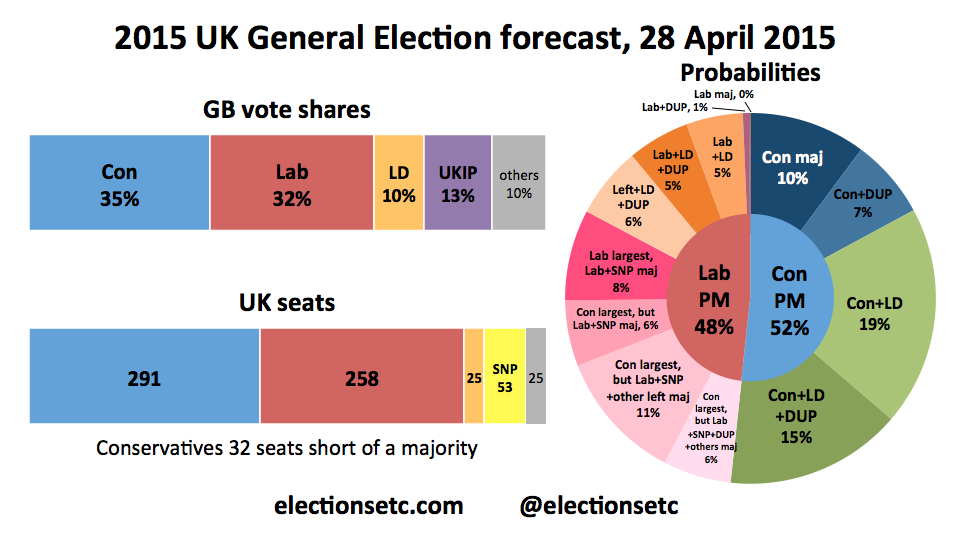
Our model now gives a 7% chance that the Conservatives will be the largest party but could only form a majority with the support of all of the Lib Dems, the DUP and UKIP. But the Lib Dems would also be able to form a majority with Labour and the SNP. In our central forecast, the Tory-led group would have 325 seats while the Labour-led group would have 338. Continue reading Which way would the Lib Dems go?→



 Elections Etc