
All posts by electionsetc

First Combined Forecast for the 2017 general election

By Stephen Fisher, John Kenny and Rosalind Shorrocks.

The betting markets, polls, statistical forecasting models and volunteer forecasters are all pointing towards a landslide majority of around 132 for the Conservatives in the UK general election on 8th June. Surveys of citizen expectations are more limited and less clear, but by our analysis they suggest that 43% of people in society at large are expecting a Tory majority of over 100.

Historically the idea of combining forecasts from different sources has had a good track record, though it has to be admitted that our attempt to do one for the EU referendum did not work out well. Most recently the pollyvote.com combined forecast of the US presidential election last year was 2 points out on the share of the vote.

This is the first of our Combined Forecasts for next month’s general election in which we aggregate seats and vote share forecasts from a variety of sources including betting markets, polls, statistical forecasting models, volunteer forecast aggregators, and citizen forecasts. We will update weekly and the methodology (as detailed below) will evolve.

All the different sources point to a big Conservative win and there is little sign of doubt that the Conservatives will get at least a majority. Various different complex forecasting models are pointing to majorities for Theresa May of between 110 and 174, with an average of 130. Betting and prediction markets are just a little more bullish with an average majority of 146.  Volunteers contributing forecasts to the Times Red Box sweepstake are only slightly more cautious. Details of the average estimate from each source, and the overall average number of seats expected for each party are in the table below.  In addition to the big Conservative majority they collectively suggest that the Liberal Democrats seat tally will only increase by four and that the SNP will be down seven.

Seats Betting Markets Complex models Simple models Volunteered Average
Con 398 390 394 380 391
Lab 158 178 173 172 170
LD 18 11 9 13
UKIP 0 0 0 0
Green 2 1 1 1
SNP 45 49 51 49
PC 3 3 3
Con majority 146 130 138 110 132

Not only are the headline forecasts from these sources remarkably strong for the Conservatives but the evidence from the polls and the models is consistent. There is also little sign of doubt among punters. The table below shows the implied probabilities of there being a Conservative majority and a Conservative landslide (100+ majority) from the betting markets, forecasting models (where available) and the polls (as judged by the proportions of polls showing the required lead). The citizen forecasts in the table show the proportion of respondents (excluding Don’t Knows) expecting each outcome. They are noticeably much more cautious and both ICM and YouGov surveys have shown as few as 30 per cent expecting a Conservative landslide.

Probabilities Betting markets Statistical Models Polls Citizen forecasts Average
Conservative Majority 0.96 0.92 1.00 0.77 0.91
Conservative landslide 0.83 0.86 0.43 0.71

The sources for vote-share forecasts are more limited but again remarkably consistent across polls, markets and forecasting models. The polling average is an average of seven different polling averages. They are at best nowcasts rather than forecasts. The statistical models give actual forecasts. Even though the polls have underestimated the Conservatives and overestimated in the large majority of general elections, and substantially so in 2015, all but three of the four forecasting models with vote shares are expecting Labour to outperform the polls and the Tories to underperform. The betting markets are expecting the opposite; an even bigger Conservative lead than the polls are showing.

% vote Polling average Betting markets Forecast Models Average
Con 46.8 47.4 45.0 46.4
Lab 28.7 26.9 27.6 27.7
Lib Dem 9.6 12.2 10.9
UKIP 6.4 3.9 6.3 5.5
Green 2.8 2.6 2.7
SNP 4.3 4.1 4.2
PC 0.6 0.6 0.6

Methodology

Continue reading First Combined Forecast for the 2017 general election
Welsh Local Election Forecasts 2017

by Stephen Fisher.

Update 18.40, 4.5.17: I was mistaken as to the method for the Rallings and Thrasher projection, the details have now been corrected. Nothing about my forecast has changed. 

This is definitely just for curiosity value only! Last week Roger Scully released the results of his Welsh Political Barometer survey which included Westminster and local election vote intention questions see here. The changes on the comparable survey from just before the last main round of Welsh local elections five years ago are presented in the first and third columns of the table below. Colin Rallings and Michael Thrasher did a seat projection based on the change from the actual 2012/3 local election vote share to the 2017 local-vote intention poll (Con +13, Lab -8, LD -1, PC +3), as discussed by Roger Scully here and listed in the second column of the table.

%Local vote Rallings & Thrasher %GE vote Regression
12-17 change seat change 12-17 change seat change
CON +9 +90 +17 +272
LAB -20 -130 -20 -320
LD 0 0 +1 +12
PC +2 +20 +1 +16

The final column of the table represents my attempt to translate the changes in the Westminster vote intention into changes in local election seats, similarly to the way I did for the English local elections. Regression analysis of local election results in Wales since 1995 shows strong linear relationships between votes and seats for each of the main parties, with the partial exception of the Liberal Democrats. On average the main parties have picked up around 16 extra seats for every percentage point extra in the overall share of the vote (just 12 for the Lib Dems).

If this relationship were to continue and if the changes in the opinion polls since 2012 were to be reflected in the results then the numbers of gains and losses would be much bigger than suggested in the Rallings and Thrasher projection. For instance Labour would be expected to lose 320 not just 130 seats.

By implication the geography of local election voting must be doing a lot of work to dampen the scale of gains and losses for the Conservatives and Labour parties in the Rallings and Thrasher projection. It would seem that there are a lot very safe Labour council seats in Wales and the system is extremely biased to Labour. The Rallings and Thrasher projection implies that the Labour would win with a 2 point lead over the Conservatives in votes, but more than twice as many seats (450 to 195). That would be extraordinarily unjust.

Projecting the changes in the Westminster vote intention on to seats with the regression method (final two columns) suggests the Conservatives will emerge (for the first time in a long time) with a substantial lead in both votes and seats.

Thanks to Eilidh Macfarlane for help with the data.

Scottish Local Elections Forecast 2017

by Stephen Fisher

The local elections in Scotland tomorrow will be conducted using the Single Transferable Vote (STV) system, a form of proportional representation. As the graph below shows, the relationship between seats and votes has been close to but not perfectly proportional in the only previous sets of STV elections. Larger parties tend to be a little over-represented, smaller parties a little under.

ScotLocalsSeatsVotes

However, the Conservatives were noticeably less well represented than might be expected from their size alone. For my seats forecasting model (a regression of seat share against first preference vote share, with zero intercept) I have interpreted these as party effects that are likely to be replicated again this week, but we shall see.

Continue reading Scottish Local Elections Forecast 2017

Forecasting English Local Election Seat Gains/Losses 2017

by Stephen Fisher

I am planning on forecasting the general election, but first things first. There are local elections this week.

My seat gains/losses forecasts for the English council elections this year are definitely more for curiosity value than to be taken very seriously. They are based on a simple model which uses change in party support in the polls since the equivalent round of elections four years ago to predict seat changes at the national level. The Conservatives are at 46% in the polls; up a massive 15 points on 2013. Labour are down 11 points in the polls since last time; extraordinary for an opposition party. With such big changes in the polls my model inevitably predicts very big net seat tally changes for these parties. But it does not take the electoral geography into account. Many of Labour’s seats are likely to be very safe and the Conservatives might find it hard to recoup many more than the 337 they lost last time.

With that caveat and with more below, my forecasts, together with those from Colin Rallings and Michael Thrasher, are presented in the table below. They also forecast UKIP -105. My modelling approach still cannot manage a sensible UKIP forecast.

 2017 Forecast Range Rallings & Thrasher
Con +430 +190 to +670 +115
Lab -315 -555 to -75 -75
LD -30 -265 to +210 +85

Continue reading Forecasting English Local Election Seat Gains/Losses 2017

Seats projections from GB and Scottish polls combined

by Stephen Fisher.

We’ve had eight Britain wide opinion polls since the election was called. Roughly in order, with the most recent first (and with thanks to Anthony Wells at UKPollingReport.co.uk for the figures and changes since the previous poll) they are:

ICM/ITV, CON 48%(+2), LAB 26%(+1), LDEM 10%(-1), UKIP 8%(nc), GRN 3%(-1)

Norstat/S Express, CON 42%, LAB 26%, LDEM 10%, UKIP 8%, GRN 6% Continue reading Seats projections from GB and Scottish polls combined

Another Labour Meltdown?

By Stephen Fisher

The polls in Scotland just before the last election showed a 21-point lead for SNP over Labour. The SNP went on to take all but one of Labour’s 41 Scottish seats.

This week Theresa May called a general election in the wake of polls showing her Conservative party 21 points ahead of Labour. Could Labour now be headed for a Britain wide meltdown of the kind that they suffered in Scotland two years ago? Continue reading Another Labour Meltdown?

Why was Trump elected?

by Stephen Fisher.

This question can be addressed from various angles and at different levels. I will start with the basic features of the result, then discuss the patterns of change since 2012, all before trying to address the bewilderment of many who find it hard to understand how anyone could vote for him.

Trump won the presidency by holding on to states that Romney won and winning some states that Obama previously won, including Iowa, Florida, Ohio, Pennsylvania and Wisconsin. He did this by a combination of a national vote swing of around 1.5 points since 2012, plus above average swings in some key battleground states, such as Pennsylvania 3 points, Michigan 5 points and Iowa 10 points.*

At the same time, Trump lost the national popular vote but won the presidency by narrowly winning Michigan, Wisconsin, Pennsylvania and Florida with leads of less that 1.5 points each. So, had the swing to Trump in these states been smaller by just 1 point then Hilary Clinton would have won outright.  This was a close election. Continue reading Why was Trump elected?

What to make of the US election forecasts?

By Stephen Fisher

The majority of forecasts point to Hilary Clinton winning tomorrow’s US presidential election. Several of the poll, market and expert forecasts with probabilities for who will win are helpfully summarised by the New York Times here.  The polls-based predictions are all, apart from one, pretty confident that Clinton will win. At the time of writing, Drew Linzer’s model at Daily Kos puts the probability of a Clinton win at 87%, HuffPost has 98% and Sam Wang at the Princeton Election Consortium estimate is as high as 99%. The New York Times’ own model is slightly less confident, on 84%. The exception is Nate Silver’s FiveThirtyEight model which puts Clinton’s chances at just 67%.

The lower probability for Clinton in the FiveThirtyEight model is partly (by comparison with most but not all models) due to 538 having a smaller estimate of her likely lead in votes. By comparison with HuffPost, for instance, this is because FiveThirtyEight put more weight on more recent polls that haven’t been so great for Clinton in wake of the FBI announcement last week of further investigations into her emails.

But the discrepancy is mostly due to the FiveThirtyEight model allowing for more uncertainty. So 538 have a higher probability of a Clinton landslide than other models as well as a higher probability of a triumphant Trump. Continue reading What to make of the US election forecasts?

Why did the UK vote to leave the European Union?

by Stephen Fisher.

It is not hard to see why Leave won. Evidence from numerous opinion polls showed that there was a clear majority for Leave on the basis of concerns about immigration and beliefs that leaving would reduce immigration. Moreover the same opinion polls showed us that there was no compensating majority who believed that the UK would be worse off if we left. Still less did people feel that they personally would be financially worse off. For further details see here.

Although it should not have come as a surprise that Leave won, the result was close enough that it could easily have gone the other way. There will be much debate as to whether the Remain side could have made their arguments more persuasively and campaigned more effectively. With such a close result a host of relatively small differences could all have made a difference. It will be hard for survey and other academic research to identify what, if anything was decisive.

Turnout, at 72%, was the highest for any UK-wide vote since 1992. Whilst this might constitute a relatively high level of participation by recent standards, it does still mean that 28% of registered voters did not bother to have their say in what, we were frequently told, was the most important national decision in our lifetimes. If opinion poll questions on likelihood of voting are at least roughly right, it is likely to transpire that non-voters more often favoured remaining. Moreover it is probably the case that if everyone eligible had voted then the UK would have chosen to Remain.

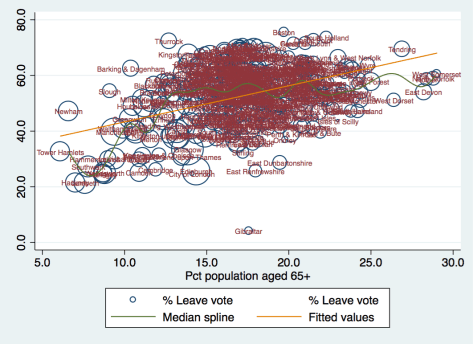
The local authority results provide some evidence that the divisions in society suggested by the opinion polls as important for referendum voting were born out. Places with more pensioners were more likely to vote for Leave.

leaverefsh_c11age65p_graph

The Remain vote was higher where there were more graduates.

leaverefsh_c11degree_graph.png

These are geographical manifestations of primarily individual-level differences. There are also others related to ethnic diversity and economic prosperity.

The national divides are the most notable aspect of the political geography. Both Northern Ireland and Scotland voted Remain (at 56% and 62% respectively). Both England and Wales voted 53% Leave.

The only region within England to vote Remain was London, and it did so strongly with 60% of the vote. Setting aside London, the rest of England voted solidly, 55%, for Leave. While it is true that the Leave vote was strongest in the English countryside, many of the big cities voted Leave, including Birmingham, Sheffield, Bradford, Sunderland, Bolton, Newcastle, and Stoke. While the North and Midlands were stronger for Leave than the South of England, there were cities in the South, such as Plymouth, Southampton and Swindon, that voted Leave.

In the end only 52 out of 293 local authorities in England outside London voted to Remain. Similarly only 5 out of 22 Welsh council areas voted to Remain. Outside London, the preference for leave was widespread in England and Wales.


Final forecast from the Historical Referendums and Polls based method

by Stephen Fisher and Alan Renwick.

The polls this week have been better for Remain than they were last week. Since this is our final forecast it makes sense for us to restrict our sample of polls to include in our polling average just the most recent poll from each company (or company-mode combination) over the last week. If we do this then our polling average finds Remain at 51 per cent after setting aside Don’t Knows. This is up two points from our polling average on Sunday. The two-point difference is partly due to restricting the sample from two weeks to just one, partly rounding error and partly to the fact that more of the polls than previously include Northern Ireland. So it is not clear whether the apparent movement towards Remain is real or not.

Our forecast share of the vote is 52 per cent for Remain, 48 per cent for Leave. This reflects an expectation of a 1.5-point rise in support for the status quo, based on the change that is visible on average between the final polls and the actual result in previous referendums in Britain or on the EU elsewhere. While this reflects the average historical experience we have explained here and here why the average may not be a very reliable guide.

The unreliability means there is a lot of uncertainty in our forecast. The 95 per cent prediction interval is considerably narrower than it was at the beginning of the week. But at ±10 points it is still very wide. So wide that Remain could reasonably be expected to get anywhere between 42 per cent and 62 per cent of the vote. Neither a comfortable Remain victory nor a comfortable Leave victory can be ruled out.

That said not all the possible outcomes in this range are equally likely. Our forecast probability that Remain will win the referendum is 64 per cent.

The methods behind our forecast

Continue reading Final forecast from the Historical Referendums and Polls based method