Category Archives: Combined forecast

Sixth and final combined forecast for the 2024 general election

By Stephen Fisher, John Kenny, Paul Furey, and Polina Ryzhuk. 3rd July 2024.

10am, 4th July. Updated to correct a minor typo. Forecasts published since the post below was published late last night but before polling stations opened this morning (and any we missed) will be incorporated in the evaluation after the results. So far it looks like those additions would make little difference to the tables below. Thanks to all the forecasters for their contributions.

The average of different kinds of seats forecasts points to a Labour majority of 194 in tomorrow’s general election. Changes since last week are: Conservative +8, Labour -3, LD +4, Reform +1, SNP -2, and no change for the Greens and PC. Those changes are partly due to moves in the betting markets, perhaps in response to polls that improved for the Conservatives, and new complex models (listed in the sources section below). However, MRP projections have worsened for the Conservatives. They are now forecasting an average of just 85 seats for the party.

Continue reading Sixth and final combined forecast for the 2024 general election

Fifth combined forecast for the 2024 general election

By Stephen Fisher, John Kenny, Paul Furey, and Polina Ryzhuk. 26th June 2024.

The average of different kinds of seats forecasts points to a Labour majority of 200; the same as last week. There is very little change for other parties, except that the average forecast for the Conservatives is down from 127 last week to 123 this week. That is despite a rise for the Tories in the simple-model projections (uniform change from opinion polls). The Conservative seat forecast is down in both the non-MRP complex models and the MRP average, which is now forecasting just 92 seats for the Conservatives. That average is now based on 9 different MRP models.

Continue reading Fifth combined forecast for the 2024 general election

Fourth combined forecast for the 2024 general election

By Stephen Fisher, John Kenny, Paul Furey, and Polina Ryzhuk. 19th June 2024.

All the different sources still point to a large Labour majority. On average across the different kinds of forecast, the predicted majority is, at 200, up eight from last week. The combined forecast for the Conservatives is down by nine seats, and that for the Liberal Democrats is up by seven seats since last week. Those changes have been largely driven by changes in MRP projections, but other sources have also typically changed in the same direction.

Continue reading Fourth combined forecast for the 2024 general election

Third combined forecast for the 2024 general election

By Stephen Fisher, John Kenny, Paul Furey, and Polina Ryzhuk. 12th June 2024.

All the different sources of seat forecasts still point to a large Labour majority. On average across the different kinds of forecast, the predicted majority is 192, down slightly from 197 last week. The Liberal Democrat forecast has crept up from 36 in our first forecast, to 37 last week, to 41 today. The betting markets are more optimistic for Reform UK winning seats than the poll-based models, as they were last week.

Continue reading Third combined forecast for the 2024 general election

Second combined forecast for the 2024 general election

By Stephen Fisher, John Kenny, Paul Furey, and Polina Ryzhuk. 6th June 2024.

All the different sources of seat forecasts still point to a large Labour majority. On average across the different kinds of forecast, the predicted majority is 197. That is up slightly from the 188 average majority in our first combined forecast this time last week.  

Table 1. Seat Forecasts

Betting MarketsComplex modelsSimple modelsMRPAverage
Con118144195114143
Lab424434392444424
LD4232284537
Reform30011
Green1111
SNP1916132418
PC3333
Lab majority199217134238197

The increase is largely due to the higher Labour forecasts from the MRP models, which are listed in Table 2. They are remarkably different from each other, ranging from a Labour majority of 114 to as much as 324. The forecast number of Conservative seats in the MRP projections range from 66 to 180. A key part of the differences between the MRP projections for the Conservatives and Labour is the degree to which the models expect party performance to be proportional to the prior Conservative vote share. By comparison, traditional uniform change models (under simple models in Table 1) produce more modest forecasts for Labour gains and Conservative losses.

Continue reading Second combined forecast for the 2024 general election

First combined forecast for the 2024 general election

By Stephen Fisher, John Kenny, Paul Furey, and Polina Ryzhuk. 30th May 2024.

Here we combine seats and vote share forecasts from a variety of sources including betting markets, polls, statistical forecasting models, and citizen forecasts. As well as updating weekly, incorporating new forecasts with different methods as they become available, there may be developments in the methodology. Comments welcome. 

All the different sources of seat forecasts in Table 1 point to a very large Labour majority, well over 100. 

Continue reading First combined forecast for the 2024 general election

How did the election forecasts do in 2019?

By Stephen Fisher, John Kenny, and Rosalind Shorrocks. 29th May 2024

Pretty well. Whereas many of the forecasts for the 2017 British general election incorrectly pointed to a Conservative majority, and sometimes a large one, in 2019 the general election forecasts correctly suggested a comfortable Conservative majority. But they did not do equally well and there are perhaps lessons to be learned for which forecasting methods might be more prescient than others this year.

Continue reading How did the election forecasts do in 2019?

Final combined forecast for the 2019 general election

By Stephen Fisher, John Kenny and Rosalind Shorrocks

Since our first combined forecast at the start of the campaign, the number of forecasts for this general election has grown substantially. All of the combined forecasts – seats, vote shares, and probabilities – are pointing to a Conservative majority. However, some individual forecasts do predict a hung parliament, and there is variation within each forecast type over how certain this majority is, and how large it is predicted to be.

SEATS

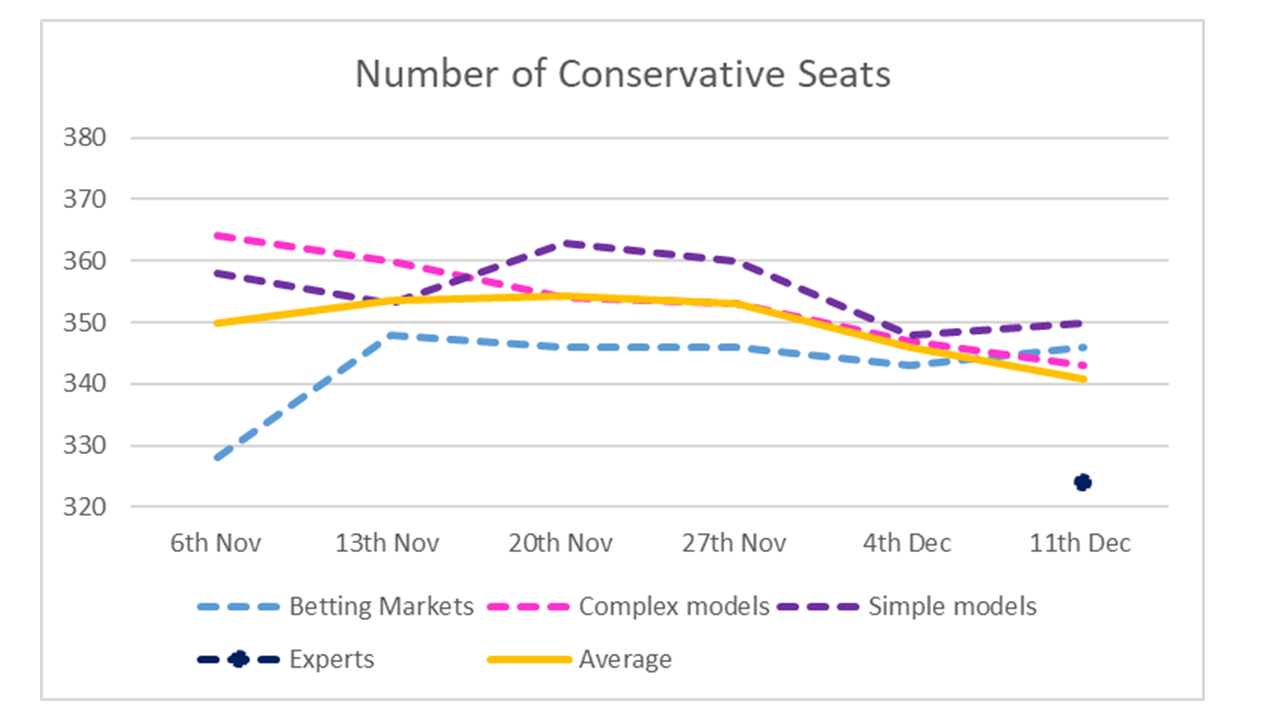
Seat projections from the betting markets, complex models, and simple models are all very similar, forecasting a Conservative majority of between 343 and 351 seats. The average number of seats across all forecasts that the Conservatives are expected to win – 341 – is slightly lower but ultimately very similar to the forecast last week.

Since last week the Political Studies Association have published their Expert Survey, in which the average expected number of Conservative seats suggests a hung parliament with the Conservatives just shy of a majority. It is interesting that the experts surveyed by the PSA predict the Conservatives will win fewer seats than is currently suggested by the polls. Perhaps they are factoring in the same kind of late-campaign changes as observed in 2017 – although it should be noted that when a similar kind of survey was run for the EU referendum in 2016, the average predicted vote share for Remain and Leave amongst experts was the furthest away from the actual result than any of the other types of forecast. They also predicted a Conservative majority in 2017, although that prediction was made much more earlier in the campaign when the Conservatives had considerable leads over Labour in the polls.

Seats Betting Markets Complex models Simple models Experts Average
Con 346 343 350 324 341
Lab 221 225 219 233 224
LD 18 17 18 25 19
Brexit 0 0 0 2 1
Green 1 1 1 2 1
SNP 43 44 41 42 43
PC 4 3 3 4 4
Con majority 42 37 49 -2 31


Conservative Seats - 11th December

The similarity between the seat projections from most sources hides considerable variation within one particular forecast type – complex models. These models range from predicting 311 Conservative seats to 366 – the difference between a hung parliament and a healthy Conservative majority. They also range between 190 and 268 for Labour. It is particularly noteworthy that the voter expectation model, from Murr, Stegmaier, and Lewis-Beck, which uses citizen forecasts to predict the number of seats, forecasts one of the highest number of Conservative seats (360) and the lowest number of Labour seats (190). This is in contrast to our implied probability calculated from the citizen forecasts, which suggest that citizens are in general the least convinced about the likelihood of a Conservative majority compared to other forecasting methods. This suggests these surveys also suffer from being open to multiple interpretations and methods of analysis, as well as the question wording effects we discussed last week.

Continue reading Final combined forecast for the 2019 general election

Fifth combined forecast for the 2019 general election

By Stephen Fisher, John Kenny and Rosalind Shorrocks 

Since our update last week there have been several new forecasts, most notably including the YouGov MRP (multilevel regression and post-stratification) model. That was a nowcast rather than a forecast, but the same is true of most of our “forecasts”. More on differences between forecasting models below, along with some observations about intriguing question wording effects for citizen forecasts.

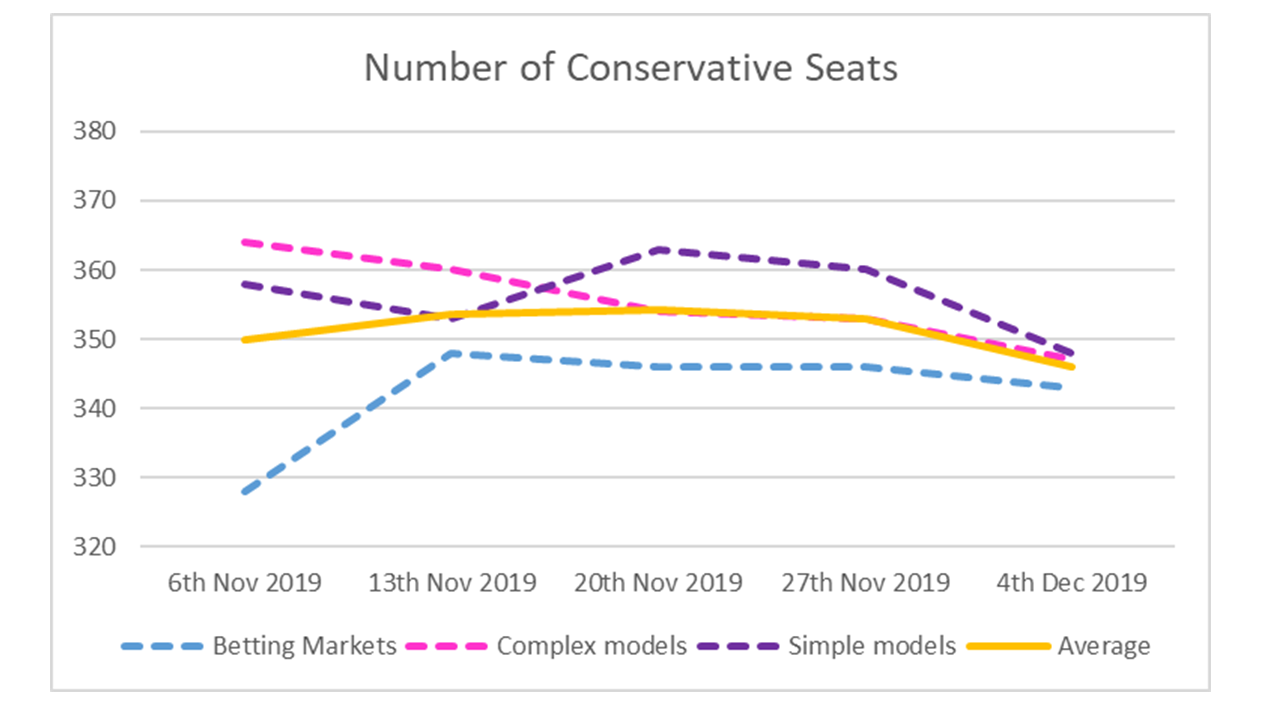
But first, overall, the seats projections overall have tightened for the Conservatives, who are down from a 353 average last week to 346 this week, while Labour are up from 209 to 218. The Liberal Democrat forecast total has dropped yet again (from 23 to 19). Now they are estimated to return fewer MPs than they had going into the election (20), but still more than the number of seats they won in 2017 (12).

Seats Betting Markets Complex models Simple models Average
Con 343 347 348 346
Lab 220 218 217 218
LD 19 18 19 19
Brexit 0 0 0
Green 1 1 1 1
SNP 45 45 44 45
PC 5 4 3 4
Con majority 36 45 46 42

Conservative Seats - 4th December

There is now remarkably little difference between the betting markets, complex and simple models in the expected size of the Conservative majority. Particularly striking is that on average the complex models differ by only a seat for each party from the simple uniform change projections based on the average of the opinion polls.

Continue reading Fifth combined forecast for the 2019 general election

Third combined forecast for the 2019 general election

By Stephen Fisher, John Kenny and Rosalind Shorrocks 

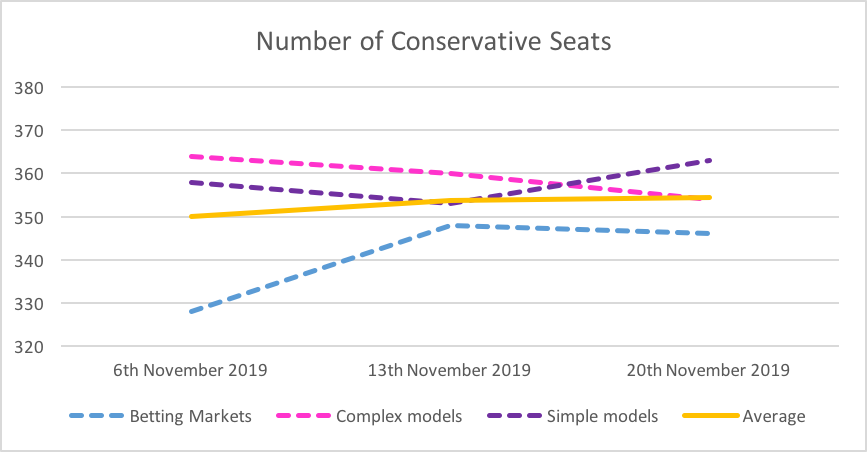
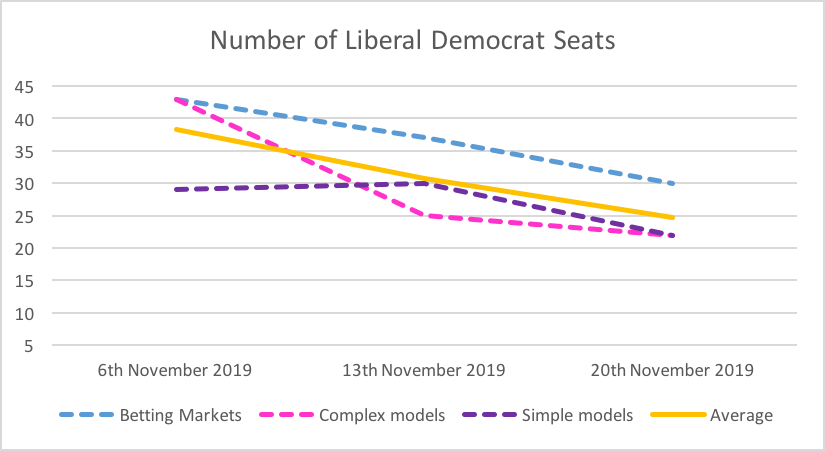
Once again all three sources of seat forecasts suggest the Conservatives are heading to a comfortable majority, while Labour are on course for a result on par with their previous post-war low of 209 seats in 1983. The Liberal Democrat forecast has been dropping steadily, so that they are now expected to end up with only a few more MPs than the twenty they had when they chose to support the election.

Seats Betting Markets Complex models Simple models Average
Con 346 354 363 354
Lab 209 211 200 206
LD 30 22 22 25
Brexit 0 0 0
Green 2 1 1 1
SNP 46 46 44 45
PC 4 4 4 4
Con majority 42 58 75 58

Con seats 20 NovLib Dem seats 20 Nov 

Continue reading Third combined forecast for the 2019 general election