This is a longer and more detailed version of a post that was originally published by Prospect here on Friday. The opinion polls published over the weekend do not collectively show any substantial change from the figures in the table below.
By Stephen Fisher, 9th September 2019.
The government has lost its majority in parliament, so it is unlikely to be long before there is a general election. Already at the last election, the Conservatives attracted most Leave voters while Labour was most popular among Remain voters. So what has changed in the party preferences of Leave and Remain voters, and with what implications for the next election?
The Conservatives lost many of their Leave voters to the Brexit Party at the European elections earlier this year largely because of the government’s failure to deliver Brexit on schedule at the end of March. At the same time, frustrated with the complexity and ambiguity in Labour’s position on Brexit, many Labour Remain voters switched to the Liberal Democrats or Greens.
Since May (the month and the leader) the challenger parties have waned and the two main parties have recovered somewhat, but Westminster-vote intentions are still closer to the multi-party competition we saw in the Euro elections than they are to the two-party dominance of the 2017 election.
The table shows how Leave and Remain voters from 2016 voted in 2017, and how they intend to vote now. The changes show that the rise of the Liberal Democrats and Greens has been largely confined to Remain voters, while the Brexit Party has, unsurprisingly, only really attracted those who voted Leave in the referendum.
Table: 2017 vote and current vote intention, by 2016 vote
| |
2017 |
2019 |
Change |
| |
Leave |
Remain |
Leave |
Remain |
Leave |
Remain |
| Con |
63 |
25 |
52 |
16 |
-11 |
-9 |
| Lab |
25 |
53 |
12 |
37 |
-13 |
-16 |
| LD |
3 |
12 |
4 |
32 |
+1 |
+20 |
| UKIP/Brexit |
4 |
0 |
27 |
1 |
+23 |
+1 |
| Green |
2 |
3 |
1 |
7 |
-1 |
+4 |
| |
|
|
|
|
|
|
Note: 2017 figures come from the British Election Study Internet panel. 2019 figures are the average of the most recent poll from each of Deltapoll, Opinium, Survation and YouGov taken between 21 August and 3 September 2019. The UKIP/Brexit row shows figures for UKIP from 2017 and the Brexit Party in 2019, and the change between the two.
What is perhaps more surprising is just how both main parties have suffered setbacks among both Leave and Remain voters. Labour have fallen back almost as much among Leave voters as they have among Remain voters. While the largest outflow from Labour in absolute numbers is that among Remain, in relative terms, it is the other way round. Labour have lost just under a third of their 2017 Remain voters, but as much as half of their former Leave voters. As a result, Labour supporters are even more predominately on the Remain side than they were in 2017. Continue reading Leavers united could easily thwart divided Remainers →

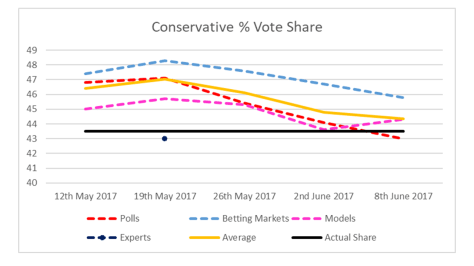 Note: Due to an error in our 2ndJune 2017 betting market calculation (and no way of correcting it at this stage) the betting market line runs direct (interpolates) from 26thMay to the final 8thJune 2017 estimate.
 Elections Etc